
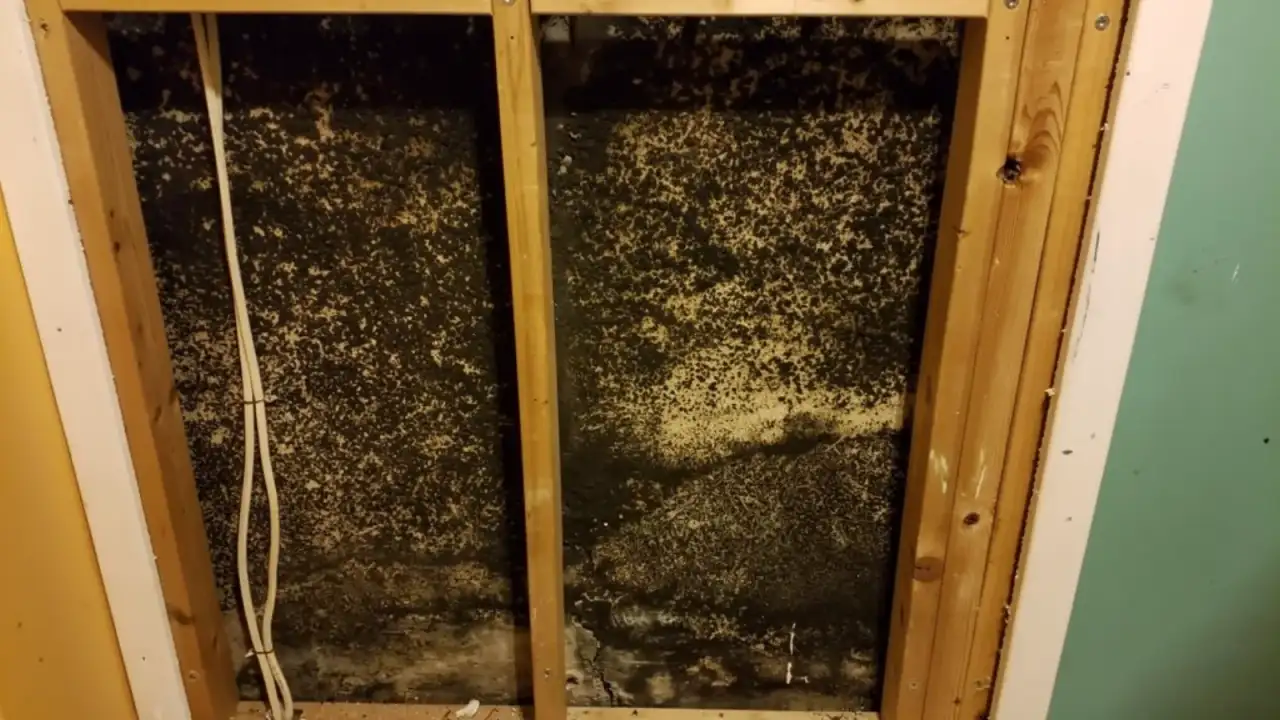
Signs you need this
- • Dark speckled patches spreading across a basement wall, often starting low near the sill plate or around a foundation crack.
- • A musty, earthy smell in a downstairs bedroom, laundry room, or finished basement that gets stronger after rain.
- • Drywall that feels soft, bows outward, or crumbles slightly at the seam near a known plumbing line or exterior wall.
- • A tenant complaint about black mold after a slow leak went unnoticed for weeks.
Springfield Elite Drywall & Plaster removes drywall that mold has already colonized, dries and verifies the framing behind it, and rebuilds the wall or ceiling with mold-resistant board so the problem doesn’t just come back under a fresh coat of paint. The crew starts by finding where the moisture is actually coming from, since replacing board over an active leak or a chronically damp foundation wall only buys a season or two. Where the affected area is small and confined to a surface-level cavity, this is a drywall repair. Where the growth is extensive, has spread through HVAC returns, or covers more than roughly ten square feet, Massachusetts guidance calls for a licensed mold remediation professional to handle containment and air testing before any demo begins, and this crew will say so plainly rather than take a job outside its scope.
What Mold Behind Drywall Actually Looks Like in Springfield Homes
Mold rarely announces itself the way homeowners expect. By the time a dark patch is visible on the painted surface of a wall, the paper facing on the back side of that same panel has usually been colonized for weeks, and the growth has often tracked sideways along the seam tape into the next stud bay. Springfield’s housing stock makes this especially common. The McKnight and Forest Park neighborhoods are full of plaster-era homes with fieldstone or rubble foundations that were never built with a modern vapor barrier, so a wet spring or a poorly graded downspout sends humidity straight into the basement walls. In the North End, South End, and Mason Square, dense three-decker construction means a leak in one unit’s bathroom or kitchen can travel through a shared wall cavity and surface as a ceiling stain a floor below, often going unreported by a tenant until it’s visible. Sixteen Acres and East Forest Park mid-century basements have their own version of the problem: finished rec rooms with a dehumidifier that got shut off for the winter, or never installed at all, sitting on top of a foundation that sweats every time the Connecticut River valley humidity spikes in July and August.
Springfield Elite Drywall & Plaster starts every mold call the same way, with a moisture meter, not a demo saw. Cutting into a wall before knowing how far the dampness has traveled means either removing more good material than necessary or, worse, missing compromised board just past the cut line and closing a fresh mold source back inside the wall. The meter reading against the framing tells the crew where sound wood starts, and that reading, not the visible stain, sets the actual cut line.
Where the Line Sits Between Drywall Replacement and Mold Remediation
This is the question every homeowner and property manager should ask before hiring anyone: is this a drywall job, or does it need a licensed mold remediation professional first? Massachusetts guidance generally treats mold coverage under about ten square feet, contained to a single accessible area with no HVAC involvement, as something a drywall contractor can safely handle: cut back the affected board, bag it for disposal, dry and verify the framing, then reboard. Beyond that scope, particularly when growth has spread into ductwork, covers multiple rooms, or the job is tied to a real estate transaction that requires documented clearance testing, the work calls for negative-air containment and a professional remediation crew before any drywall work resumes. Springfield Elite Drywall & Plaster draws this line honestly rather than taking on demo work that belongs to a remediation specialist, and will recommend that step, and work alongside a remediation contractor once the space has been cleared, rather than skip it to save the homeowner a phone call.
Pre-1978 housing, which describes a large share of Springfield’s older stock, adds another layer before demo can begin. EPA RRP lead-safe work practices apply any time painted surfaces from that era are disturbed, and where asbestos-containing materials are suspected in older plaster or joint compound, the MA Dept. of Labor Standards and MassDEP have their own testing and handling requirements. None of this is optional paperwork; it changes how the crew sets up containment and what protective steps happen before the first cut.
Rebuilding the Wall So the Mold Doesn’t Come Back
Once the source of moisture is identified, whether that’s a foundation crack letting groundwater in after heavy rain, a slow supply line behind a bathroom wall, poor exterior grading pushing water toward the sill, or an old ice-dam leak from a roofline that was never fully dried out, fixing that source comes before any new board goes up. Reboarding over an active leak or a basement that still runs damp all summer only delays the same call by a season. The framing gets time to dry, and a follow-up moisture reading confirms it’s back in a normal range before anything closes it in.
For the rebuild itself, moisture-resistant or mold-resistant board such as USG Mold Tough, USG PURPLE, Gold Bond XP, Gold Bond eXP, or DensArmor Plus replaces standard panel in basements and other consistently damp areas, paired with a setting-type compound rather than standard joint compound where humidity runs high year-round. In a bathroom or utility area prone to direct moisture contact, RedGard or a similar liquid membrane sometimes goes down at the base of the wall as extra insurance. Type X board comes into play where the assembly also needs a fire rating, common in shared three-decker walls between units. Finish level depends on who’s living with the result: a rental turnover in a North End three-decker typically gets a clean Level 4 finish to match quickly and get the unit back on the market, while a primary living space, especially one with a window letting in raking light across the wall, often calls for the smoother Level 5 finish so the repair disappears entirely.
Documentation That Matters for Landlords and Sellers
Property managers dealing with a tenant mold complaint, and homeowners mid-sale with an inspector’s report in hand, need more than a fixed wall. They need a record of what was found, what was removed, what caused it, and what was done to prevent recurrence, since that documentation is often what satisfies an insurance adjuster, a buyer’s attorney, or a health department inquiry. Springfield Elite Drywall & Plaster walks through those findings with the homeowner or manager at the end of the job, not just a punch list of what was patched.
Materials & standards
Products & materials we use
- USG Mold Tough
- USG PURPLE
- Gold Bond XP
- Gold Bond eXP
- DensArmor Plus
- DensGlass
- M2Tech mold-resistant board
Standards & codes we work to
- 780 CMR
- EPA RRP (pre-1978 lead-safe practices)
- ICRA containment concepts
- GA-214 finish levels
- MassDEP
- MA Dept. of Labor Standards (asbestos)
What the terms mean
- Moisture-meter diagnosis
- Negative-air containment
- Setting-type compound
- RedGard
- Type X board
- Relative humidity
- Remediation versus replacement
- Three-decker
- Basement mold
Options & variants
| Option | When it applies | Cost |
|---|---|---|
| Spot cut-out and patch | Isolated staining on one panel, source already fixed (old leak, resolved) | Lower cost, single-day turnaround |
| Full wall or ceiling section replacement | Mold has tracked along a seam or up a stud bay past the visible stain | Moderate, driven by square footage and framing drying time |
| Basement finished-space rebuild | Long-term basement humidity has affected multiple walls, baseboards, or the bottom plate | Higher, includes framing inspection and often a vapor or humidity fix alongside the drywall |
| Post-remediation reboard | A licensed remediation company has already removed material and cleared the space | Varies with finish level requested |
What affects cost
- • How much of the wall or ceiling the mold has reached versus how much is a precautionary cut-back past the visible line.
- • Whether the moisture source is already fixed or still needs a plumber, mason, or grading fix before drywall goes back up.
- • Access: an open basement stud bay is straightforward, but mold behind finished trim, built-ins, or a tiled tub surround adds labor.
- • Board choice: standard moisture-resistant board versus a heavier mold-resistant product like USG Mold Tough or Gold Bond XP for a chronically damp basement.
- • Finish level requested, since a rental unit often needs a fast Level 4 match while a primary living space may call for Level 5.
- • Whether asbestos or lead testing is required first because the home predates 1978, which adds time before demo can start.
What to expect
- 1
Map the moisture
The crew walks the affected area with a moisture meter to map how far the dampness has actually traveled inside the wall, not just where the stain shows.
- 2
Identify the source
They identify the source, whether that's a foundation crack, a slow supply line, poor grading, or an old ice-dam leak from the roofline, and confirm with the homeowner what needs fixing before reboard.
- 3
Bring in remediation if the scope calls for it
Where the area is large or the growth extensive, they pause and bring in or recommend a licensed mold remediation contractor for containment and removal under negative air, since that step is outside a drywall crew's scope.
- 4
Cut back and dry
Once demo is clear, they cut back compromised board past the visible mold line into sound material, bag and remove it, and let the framing dry to a verified moisture reading before closing anything up.
- 5
Rebuild and finish
They hang mold-resistant board, tape and finish to the level the space calls for, and walk the homeowner or property manager through what was found and what to watch for going forward.
When this isn’t the right call
- If mold covers a large area, has spread into HVAC ductwork, or the job needs documented air-quality testing for a real estate transaction, a licensed mold remediation professional should handle removal first.
- If the home was built before 1978 and paint testing hasn't been done, water damage drywall repair with lead-safe (EPA RRP) testing is the better starting point.
- If the staining is cosmetic discoloration with no odor, softness, or history of active moisture, a simple paint or cleaning job is a better fit than replacement.
- If the issue is ongoing structural water intrusion with no fix identified yet, resolving the water source with a plumber or foundation contractor comes before any drywall work.
Frequently asked questions
Can you just cut out the moldy spot, or does the whole wall need to come down? +
It depends on how far the moisture traveled inside the cavity. Springfield Elite Drywall & Plaster uses a moisture meter to find the edge of the damp material, not just the visible stain, and cuts back past that line so nothing compromised gets closed back in.
Do I need a mold remediation company, or can a drywall contractor handle this? +
For a contained area, typically under about ten square feet, a drywall crew can safely remove and replace the board. Larger areas, HVAC involvement, or a real estate transaction requiring documented clearance usually call for a licensed remediation professional first.
What kind of board do you use for a basement that's had mold before? +
Mold-resistant board such as USG Mold Tough, Gold Bond XP, or DensArmor, paired with a setting-type compound rather than standard joint compound in consistently damp basements.
My house is a three-decker built in the early 1900s. Does that change anything? +
Yes. Pre-1978 properties require EPA RRP lead-safe work practices, and depending on the material found, MassDEP and MA Dept. of Labor Standards asbestos rules can apply before any demo starts.
Will the mold just come back after you replace the drywall? +
Not if the moisture source gets fixed first. Replacing board over an active leak or an uncorrected humidity problem only delays the same call. This crew won't close up a wall until the framing reads dry.
I'm a landlord with a tenant complaint about black mold. How fast can you get out there? +
Mold complaints from tenants move fast on the priority list, since they carry health and liability exposure. Call for same-week assessment in most cases.
What finish level do you leave the wall at? +
Rental turnovers typically get a Level 4 finish for a fast, clean match. Primary living spaces or areas with raking light often call for Level 5.