
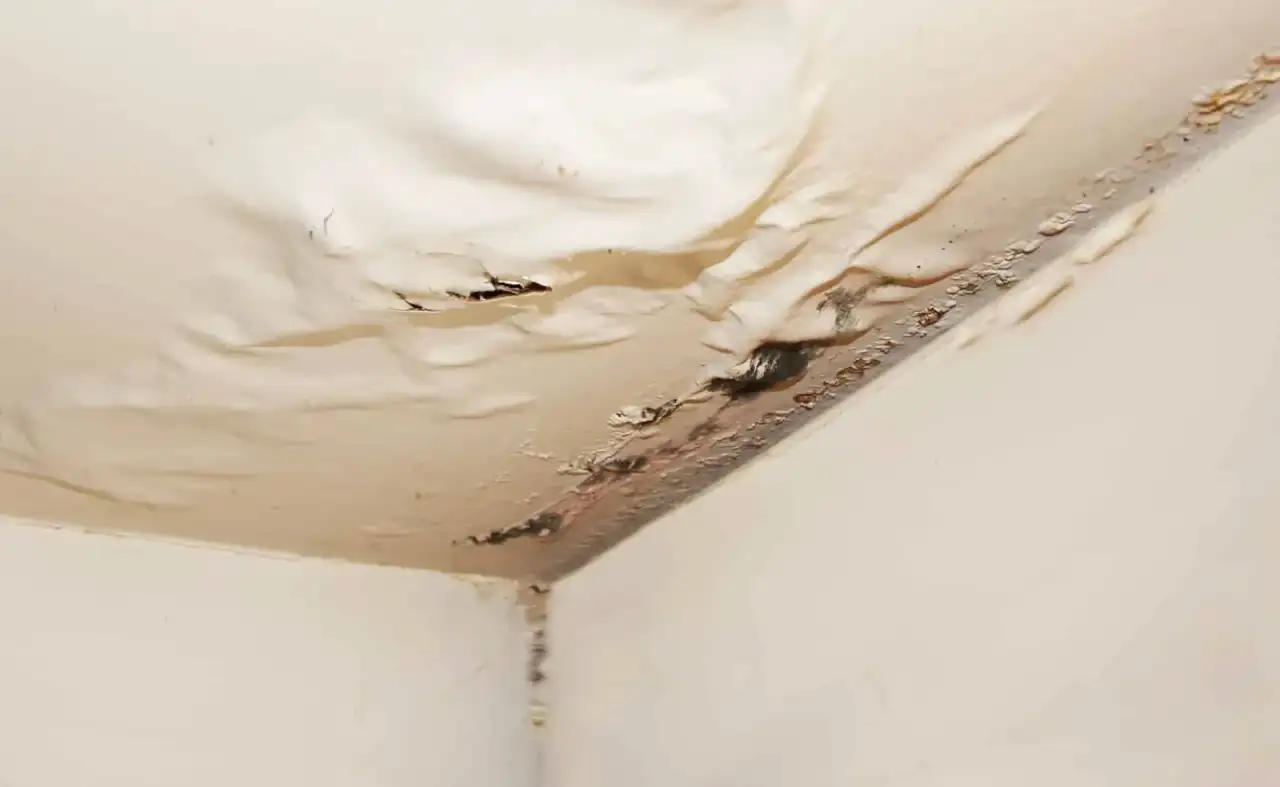
Signs you need this
- • A brown or yellow ring spreading across a ceiling, usually below a bathroom, roof valley, or old plumbing run
- • Drywall that has gone soft, spongy, or is bulging and sagging away from the framing overhead
- • A musty smell in a basement or first-floor room after heavy rain or a Pioneer Valley freeze-thaw stretch
- • Paint bubbling, peeling, or joint tape lifting along a wall or ceiling seam
- • Standing water or a soaked baseboard after a burst pipe, water heater failure, or ice dam backup
What Water Damage Does to Drywall (and Why Speed Matters)
Gypsum board is essentially compressed rock encased in paper, and both halves of that combination fail differently when they get wet. The paper facing wicks moisture and becomes a food source for mold within a day or two in Pioneer Valley humidity; the gypsum core itself softens, loses its bond to the framing, and starts to sag under its own weight once it’s saturated. That’s why a ceiling stain that looks cosmetic from below is rarely just cosmetic: by the time discoloration shows through paint, water has usually been sitting in the cavity above for long enough to compromise the board itself. Springfield Elite Drywall & Plaster starts every job with a moisture meter rather than a visual guess, because the visible stain and the actual wet area are almost never the same size. A stain the size of a dinner plate can sit above framing bays that are wet three or four feet in every direction, especially where water has traveled along a joist before finding a low point to show through.
Springfield’s Housing Stock Makes This a Recurring Problem
Springfield’s building stock skews old, and old buildings leak in predictable ways. The Victorian housing around McKnight and Forest Park was built with lath-and-plaster assemblies over a century ago, and that original plumbing and roofing is well past its expected service life in a lot of these homes. The city’s deep three-decker rental belt through the North End, Brightwood, South End, Old Hill, and Mason Square adds a different failure mode: shared plumbing stacks and roofs serving multiple units, where a leak on the third floor can travel down through two more ceilings before anyone notices. In the mid-century ring of Sixteen Acres and East Forest Park, ice dams are the more common culprit; a Connecticut River valley winter with freeze-thaw cycles backs meltwater up under shingles and into the ceiling assembly below the eave line, and that pattern repeats every winter until the roof or the flashing gets addressed. Springfield Elite Drywall & Plaster sees all three patterns regularly enough to recognize which one is likely just from where the stain sits and what kind of building it’s in.
Cutting Back to Sound Board, Not Just the Visible Stain
The standard approach on a water-damaged section is to cut back past the visible damage to board and framing that reads dry on the moisture meter, not just to the edge of the stain. Stopping short and patching over marginally damp board is the single most common shortcut that leads to a callback: the trapped moisture keeps feeding mold behind the new drywall, and the homeowner ends up paying for the same repair twice. Once the compromised material is out, the framing and any adjacent board get time to dry, and Springfield Elite Drywall & Plaster checks that moisture content with the meter again before closing anything up, generally targeting below roughly 16%, which is the range framing needs to reach before new drywall can go over it without trapping moisture in the cavity.
Choosing the Right Board for the Location
Not every water-damaged section gets rebuilt with the same material. A ceiling above a bedroom with no ongoing moisture exposure goes back together with standard Sheetrock or Gold Bond board. A basement wall, a bathroom-adjacent cavity, or any location with a repeat moisture history gets moisture-resistant board like M2Tech purple board or DensArmor, which resists mold growth better in a space that’s likely to see moisture again. Where fire-rated assemblies are required by code, such as certain three-decker party walls and ceilings between units, Type X board goes in to maintain that rating. Springfield Elite Drywall & Plaster makes this material call based on the location and the building’s history, not by defaulting to the cheapest option across the board.
Finishing So the Repair Disappears
The taping and finishing stage is where a repair either blends in or reads as an obvious patch, and it’s often the step a less careful contractor rushes. Seams get taped with FibaTape or paper tape and built up with several coats of setting-type or pre-mixed joint compound, feathered wide enough that the transition to the existing wall isn’t detectable by hand or under angled light. Most rooms only need a Level 4 finish, but a wall that sits under a window or a ceiling under strong can lighting shows every imperfection at a Level 5 finish, so Springfield Elite Drywall & Plaster matches the finish level to how the surface will actually be lit, not just to a generic standard. On the older McKnight and Forest Park homes with original plaster ceilings, matching the exact hand-troweled texture of century-old plaster is rarely practical for a small repair; in those cases, the honest approach is often to transition the patched section to drywall and skim-coat the seam so it reads consistently once painted, rather than promising an invisible plaster match that won’t hold up.
Insurance Claims and Documentation
Burst pipes, water heater failures, and other sudden water events are typically covered by homeowner’s insurance, and adjusters expect specific documentation before approving a scope: moisture readings showing the extent of the damage, photos of the opened cavity, and a written estimate that itemizes the work rather than a lump-sum number. Springfield Elite Drywall & Plaster provides that documentation as a matter of course on any claim-driven job, which keeps the estimate from getting kicked back for more detail and speeds up the homeowner’s payout. Slow leaks and long-term moisture, like a recurring ice dam that’s stained a ceiling over several winters, are handled differently by most policies and sometimes fall outside coverage, so it’s worth having that conversation with the adjuster early rather than assuming every water stain is a covered claim.
Working in Occupied Three-Deckers
Landlords and property managers calling about a wet ceiling in an occupied three-decker unit usually want to know one thing first: does the tenant need to move out? In most cases, no. Springfield Elite Drywall & Plaster contains the work area with plastic sheeting and a dust barrier and completes the cut-out, dry-out, and finish work with the unit still occupied, scheduling around the tenant where possible. Full vacancy only becomes necessary when the damage spans multiple rooms or when mold remediation requires sealing off a larger area, which is uncommon for a single leak caught at a reasonable stage.
Materials & standards
Products & materials we use
- USG Sheetrock
- Gold Bond
- Gold Bond XP
- DensArmor
- M2Tech moisture-resistant (purple) board
- FibaTape
- RedGard
Standards & codes we work to
- 780 CMR (Massachusetts State Building Code)
- GA-214 finish Levels 0-5
- ASTM C1396
- EPA RRP (pre-1978 lead-safe practices)
- ICRA (infection control risk assessment for occupied/sensitive spaces)
What the terms mean
- moisture-meter diagnosis
- cut back to sound board
- dry and verify cavity below ~16% moisture
- mold-resistant board install
- Level 4/5 finish match
- dust containment
- water-stained ceiling
- sagging drywall
- burst pipe
- ice dam
- lath and plaster
- three-decker
- setting-type versus pre-mixed joint compound
- Type X board
Options & variants
| Option | When it applies | Cost |
|---|---|---|
| Spot patch and finish match | Localized stain or small cut-out where the source has been fixed and no mold is present | Lower cost, driven mostly by finish-match labor on textured or older plaster walls |
| Full ceiling or wall section replacement | Sagging or delaminated board, widespread staining, or damage across multiple framing bays | Higher cost, more board and finish area, may require ceiling texture rework |
| Moisture-resistant board upgrade | Basements, bathroom-adjacent walls, or any cavity with a history of repeat moisture | Modest upcharge for moisture-resistant board over standard Sheetrock |
| Lath-and-plaster water repair | Pre-war McKnight and Forest Park homes where the original assembly is plaster over wood lath | More labor-intensive; often transitions the repaired section to drywall |
| Insurance-scoped repair | Claim-driven jobs requiring documentation, moisture readings, and a written estimate | Scope and paperwork add coordination time, not typically material cost |
What affects cost
- • How much of the ceiling or wall has to be cut out versus spot-patched, and whether the damage crosses multiple framing bays
- • Access: a first-floor ceiling under an open stairwell is straightforward, while a three-decker top-floor ceiling or a tight basement stairwell adds labor
- • Whether the existing surface is plaster and lath versus drywall, since matching old plaster texture takes more skilled hand work
- • Finish level required to blend the patch: a wall under raking light from a window costs more labor than a flat ceiling under diffuse light
- • Whether mold remediation or additional drying time is needed before board can go back up
- • Board type: standard Sheetrock versus moisture-resistant purple board or Type X where code or history calls for it
- • Whether the job is a straightforward per-job repair or requires insurance documentation and adjuster coordination
What to expect
- 1
Call and get scheduled
Describe whether it's active water or an old stain; same-day response is prioritized for active leaks or flooding.
- 2
On-site assessment
Springfield Elite Drywall & Plaster finds the water source if it isn't already known, checks moisture levels with a meter, and identifies how far the damage extends into the cavity.
- 3
Containment and cut-out
The work area is contained to control dust, then compromised drywall or plaster is cut back to sound material.
- 4
Dry and verify
Framing and cavity are dried and re-checked with the moisture meter to confirm they are dry enough to close back up.
- 5
Rebuild and finish
New board goes in, often moisture-resistant where the location calls for it, and is taped and finished to match the surrounding surface.
- 6
Walkthrough and documentation
Final walkthrough and cleanup, with photo documentation and a written scope provided if the job is tied to an insurance claim.
When this isn’t the right call
- If mold has already spread visibly across a large area or into the HVAC system, a mold remediation specialist is the better first call before drywall work begins
- If the water source is an active roof leak or failing plumbing that hasn't been fixed yet, that repair needs to happen first, or the drywall work will just fail again
- If the whole home suffered flood-level water intrusion, such as basement flooding or storm surge, a full restoration contractor coordinating structural drying is the better first call
- If the damage is cosmetic settling cracks or nail pops with no water history, that's a standard drywall repair, not a water damage repair
Frequently asked questions
How fast can you get someone out for an active leak? +
Springfield Elite Drywall & Plaster treats active water intrusion as an emergency call and prioritizes same-day response where scheduling allows, since every hour a cavity stays wet increases the odds of mold taking hold.
Will my homeowner's insurance cover this? +
Most policies cover sudden water damage like a burst pipe, though coverage for slow leaks or long-term moisture, like an ice dam that's been recurring for years, varies by policy. Springfield Elite Drywall & Plaster provides moisture readings, photos, and a written scope that adjusters typically require for a claim.
Do you match the existing texture and paint? +
Yes. The repaired section is finished to match the surrounding wall or ceiling, typically a Level 4 finish for most rooms or Level 5 where the surface will see raking light, such as near a window or under strong ceiling lighting.
My ceiling is original plaster, not drywall. Can you still fix it? +
Springfield Elite Drywall & Plaster repairs water-damaged plaster and lath common in McKnight and Forest Park homes. Depending on the extent of the damage, the repaired section is either patched in plaster-matching compound or transitioned to drywall, since exact plaster texture matching isn't always practical for a small area.
How do you know the wall is actually dry before you close it back up? +
A moisture meter checks the framing and any remaining board before new drywall goes in. Springfield Elite Drywall & Plaster verifies the cavity is dry, generally below about 16% moisture content, rather than estimating by eye or time elapsed.
I manage a three-decker and a tenant reported a wet ceiling. Can this be done without moving the tenant out? +
In most cases, yes. Water-damaged ceiling and wall sections can typically be repaired with the unit occupied, with dust containment set up around the work area; full vacancy is only needed for extensive, multi-room damage.
What's the difference between a spot repair and cutting out a bigger section? +
If the moisture meter shows the damage is contained to a small area with dry board around it, a spot patch is enough. If moisture has traveled along the framing or spread across multiple joist bays, cutting back further prevents leaving hidden wet material behind the new board.