
Signs you need this
- • Spiderweb cracks radiating from doorways and window corners, or long cracks running the length of a ceiling
- • A section of plaster wall that feels soft, springy, or sounds hollow when tapped, a sign it has separated from the lath behind it
- • Sagging or bulging ceiling plaster, sometimes with a visible drop at the center of the room
- • Patches of old plaster that have already been repaired multiple times and keep failing in the same spot
- • Powdery white residue or fine cracking (crazing) across a painted plaster surface
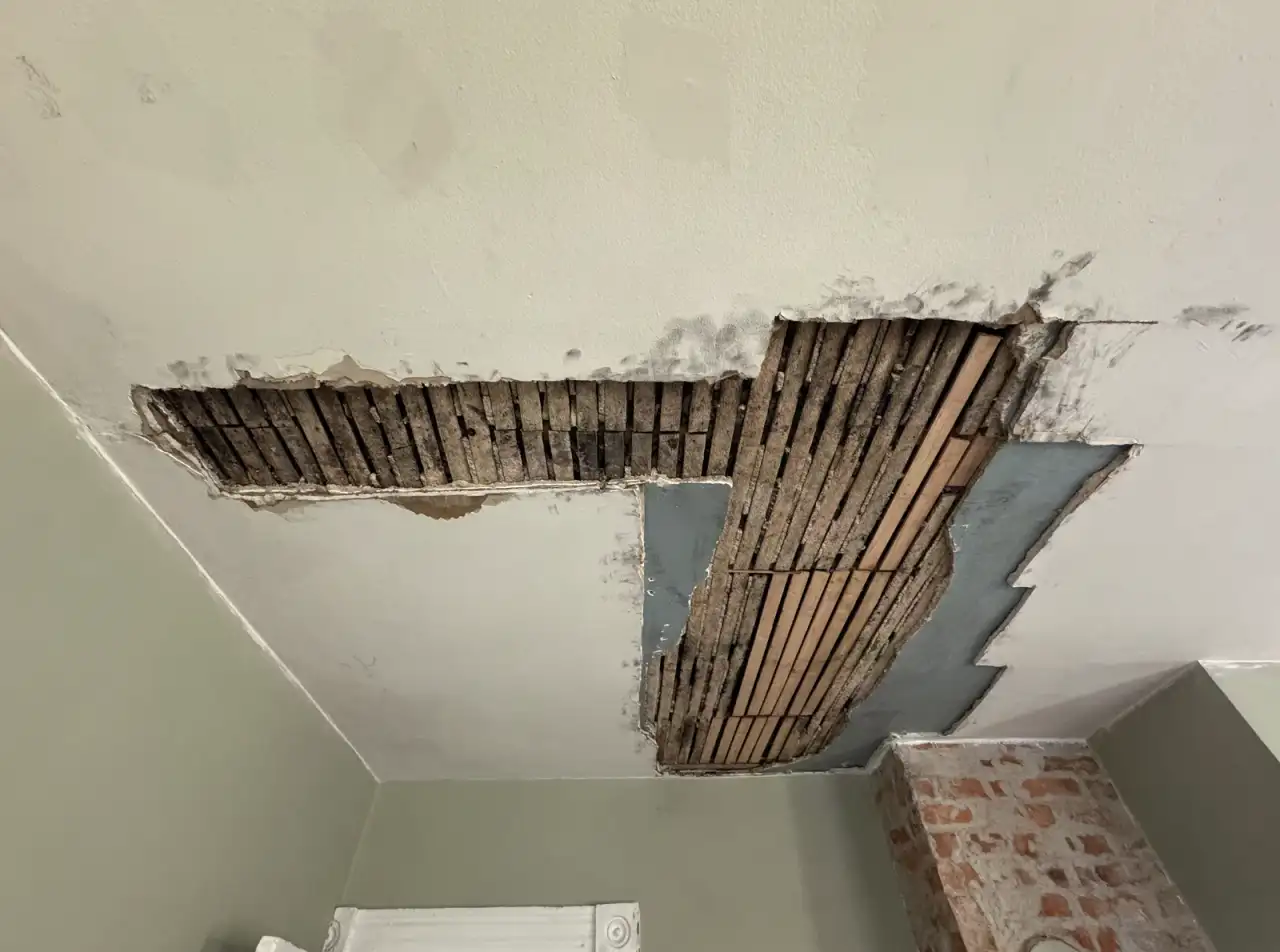
- • Bare wood lath showing through a hole where a chunk of plaster has already let go
Plaster Repair and Plaster-to-Drywall Conversion in Springfield
Springfield’s older neighborhoods carry some of the city’s densest stock of lath-and-plaster construction. McKnight Historic District and the streets around Forest Park are lined with Victorian-era homes built roughly between 1890 and 1925, and three-deckers across the city’s older cores carry the same wall system, unit after unit. Plaster over wood lath is a durable, solid assembly, but a century in it starts to lose its grip. The first real question isn’t how to fix a crack. It’s whether the plaster underneath is still worth saving.
How plaster fails, and how it gets read
Plaster holds to wood lath through keys, the small plugs of plaster that squeezed between the lath strips and hooked over them while it was wet. Over decades, vibration, settling, and moisture break those keys, and the plaster field starts to pull away from the lath even when the surface still looks intact. That’s why a wall sounds hollow when tapped, why a ceiling bellies downward, and why cracks keep coming back no matter how many times they’re painted. Springfield Elite Drywall & Plaster taps and presses the surface to map where the plaster is still keyed and where it’s let go before recommending anything. A crack is usually just the visible edge of a larger area that has separated.
Repair: saving the original plaster
When the plaster is mostly sound, it’s worth saving. Plaster washers, small perforated discs screwed through the plaster into the lath or framing, pull a sagging or loose field back tight and re-secure it without tearing the wall or ceiling out. Cracks are cleaned and filled with setting-type compound so the underlying movement doesn’t telegraph back through the next coat of paint, rather than just filled over. Then the surface is skim coated flat and feathered into the surrounding wall. In a McKnight Victorian, keeping the original plaster and matching its detail around medallions, coves, and trim is worth the extra care.
Conversion: when drywall is the right call
Sometimes the plaster is too far gone, widely detached, sagging across a whole ceiling, or already patched and re-patched more than once. Converting that surface to blue board or standard drywall gives a flatter, more durable result. Failed plaster comes out down to the framing or lath, and the new board is hung, taped, and finished to the agreed level, Level 4 for most walls, Level 5 for a wall that sits under strong window light. Blue board finished with a veneer plaster skim coat gets closer to the hardness and feel of the original wall than standard drywall alone; standard drywall taped and finished in joint compound costs less and suits most rooms just as well.
Living in the house, and lead
Plaster work is dusty, so the work area is contained with dust barriers and floor protection. Because most homes in McKnight and Forest Park predate 1978, lead paint is a real possibility under later coats, and EPA RRP lead-safe practices are followed as a matter of course on any pre-1978 plaster that gets cut, sanded, or removed. Larger conversion jobs typically go through the City of Springfield Building Department under 780 CMR, and Springfield Elite Drywall & Plaster handles that permitting as part of the job. Whether it’s a single recurring crack in a Forest Park colonial or a full three-decker unit conversion, what a homeowner gets is an honest read on which walls actually need saving, and a finish that respects the house instead of fighting it.
Materials & standards
Products & materials we use
- Structo-Lite veneer/basecoat plaster
- USG board
- Gold Bond board
- FibaTape mesh tape
Standards & codes we work to
- 780 CMR (Massachusetts State Building Code)
- GA-214 finish Levels 0-5
- EPA RRP (pre-1978 lead-safe practices)
- ASTM C1396
What the terms mean
- Lath and plaster
- Plaster keys, key loss
- Skim coat
- Level 5 finish
- Blue board, veneer plaster
- Plaster washers (button washers)
- Setting-type hot mud versus pre-mixed compound
- Bonding agent
- Mesh versus paper tape
- Knockdown and texture matching
- Dust containment
- Plaster-to-drywall conversion, re-keying
Options & variants
| Option | When it applies | Cost |
|---|---|---|
| Crack repair and re-keying | Plaster is sound overall with isolated cracking or minor key loss, and the original surface is worth saving | Lower cost, smallest scope |
| Skim coat resurfacing | Plaster is structurally sound but crazed, patched, or uneven across a whole wall or ceiling | Priced by the square footage of surface prepped and coated |
| Section replacement | A localized area has failed completely, such as a collapsed ceiling patch or water-damaged section, but the rest of the room is fine | Cost scales with the size of the failed section and ceiling versus wall labor |
| Full plaster-to-drywall conversion | Plaster has failed broadly across a room, or the owner wants a modern, crack-resistant surface | Highest cost, includes demo, disposal, new board, and finish |
| Plaster-to-blue-board veneer conversion | Owner wants to preserve the look and feel of a true plaster wall with new-construction reliability | Priced above a standard drywall conversion for the veneer plaster finish |
What affects cost
- • How much of the existing plaster is salvageable versus needs full removal
- • Ceiling work costs more than wall work per square foot, given the overhead labor and the weight of wet plaster or board overhead
- • Whether lead-safe (EPA RRP) containment and disposal is required for pre-1978 plaster and paint layers
- • Access and staging: tall Victorian ceilings, tight stairwells in three-deckers, or furniture and finished floors that need protecting
- • Finish level requested: a Level 4 finish for a bedroom wall versus a Level 5 finish for a surface under raking light from a large window
- • Whether trim, plaster medallions, or other historic detail needs to be removed, protected, and reinstalled around the work area
- • Texture or pattern matching where the new surface meets original, untouched plaster
What to expect
- 1
On-site assessment
We tap and press the affected plaster to map where the keys have failed versus where it's still bonded to the lath, and check for pre-1978 lead paint layers.
- 2
Straight recommendation
We tell you plainly whether the wall calls for repair and re-keying, a skim coat, or conversion to blue board or drywall, and explain the reasoning in plain terms.
- 3
Containment and lead-safe setup
The work area is sealed with dust barriers and floor protection, with EPA RRP lead-safe practices followed on any pre-1978 surface that gets cut, sanded, or removed.
- 4
Repair or conversion
Repair path: loose plaster is secured to the lath with plaster washers, cracks are cleaned out and filled with setting-type compound, and the surface is skim coated smooth. Conversion path: failed plaster is stripped to the framing or lath, and blue board or drywall is hung, taped, and finished.
- 5
Finish and match
The surface is coated to the agreed finish level, Level 4 for most walls or Level 5 for surfaces under strong window light, sanded, and matched to adjoining original plaster where the two meet.
- 6
Final walkthrough
We check the surface with you under normal room lighting to confirm it's smooth, crack-free, and ready for primer.
When this isn’t the right call
- If the damage is limited to a small drywall-only area with no lath or plaster involved, drywall repair is the better fit, not a plaster conversion.
- If the ceiling or wall damage is from an active or recent water leak rather than age-related plaster failure, water damage drywall repair addresses the leak first.
- If the project is a brand-new room addition or full gut with no existing plaster to work around, new construction drywall installation is the right scope.
Frequently asked questions
Can you save original plaster instead of tearing it all out? +
In most cases, yes. If the plaster keys are still gripping the lath and the cracking is surface-level, Springfield Elite Drywall & Plaster re-keys the loose sections with plaster washers and skim coats over the repair, keeping the original wall intact.
How do you know if a wall needs full conversion instead of repair? +
It comes down to how much of the plaster has separated from the lath. A tap test across the surface shows where the bond has failed. If key loss covers most of a wall or ceiling, patch repairs won't hold long-term and conversion to blue board or drywall is the more durable call.
Will the repaired area match the rest of my plaster wall? +
The goal is a seamless blend. Springfield Elite Drywall & Plaster skim coats repaired sections to match the surrounding texture and finish level, and feathers the edges so the transition doesn't read as a patch once it's painted.
Is lead paint a concern in my McKnight or Forest Park home? +
Most homes in those neighborhoods predate 1978, so lead paint is a real possibility under later coats. Springfield Elite Drywall & Plaster follows EPA RRP lead-safe practices for containment, cutting, and disposal on any pre-1978 plaster work.
What's the difference between drywall and blue board conversion? +
Standard drywall is taped and finished with joint compound. Blue board is a plaster base that gets a veneer plaster skim coat instead, which gives a harder, more plaster-like surface and feel, closer to what the original walls had.
Do I need a permit to convert plaster to drywall? +
Larger conversion jobs typically go through the City of Springfield Building Department under the Massachusetts State Building Code, 780 CMR. Springfield Elite Drywall & Plaster handles that process as part of the job scope.
My ceiling plaster is sagging but hasn't fallen. Is it urgent? +
A visibly sagging ceiling means the keys holding it to the lath have significantly failed and it's at risk of a section letting go. It's worth getting assessed promptly rather than waiting.
Can you match plaster texture around a decorative element like a medallion or cove? +
Yes. Detail work around medallions, coves, and other historic trim is handled carefully, protecting or removing the element first and matching the surrounding texture once the repair or conversion is finished.